
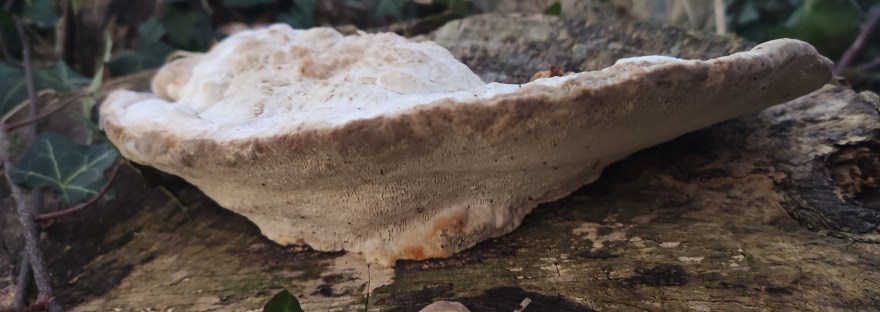

A wintry dusk stroll around the historical Glasnevin Cemetery in Dublin revealed a colourful array of lichen and some curious brackets and crusts too on the old trees and stumps.
This pale, chunky, lumpy specimen, Trametes gibbosa, common English name ‘lumpy bracket’, was covering a cluster of sycamore stumps. Amongst the deep fallen burned umber and ochre coloured leaves, the tangled green ivy, these prominent lumps protruded through their tangled friends, revealing themselves in their abundant ecosystem.
It has a soft felty texture on the top, can be found on wood of deciduous (trees that lose their leaves at the end of their growing season) trees, most often on beech. They fall in to the family Polyporaceae – polypore fungi – most members of this family have pores instead of gills. Trametes gibbosa can be identified from other Trametes by the pores being elongated, rather than circular or oval. Where Trametes gibbosa is attached to its host it is more bulbous – hence ‘gibbosa’ which means humped or rounded (hence also the term gibbous moon!).


It can be seen at all times throughout the year, sporulating in spring. Older specimens are described as being more brown on their top side and even green due to an algal crust that forms on them over time. And Michael Jordan in his Encyclopedia notes that they are frequently attacked by boring beetle larvae which leave granular deposits nearby.
Lumpy bracket appears across Ireland, the UK and mainland Europe in temperate climates. Cate2 currently holds 3423 records across all counties of mainland Britain, most noted on beech and sycamore, in woodland, parkland, heath and roadsides. The first record is from 1860 and the last, at time of writing was on the 25th December 2021. Ireland’s National Biodiversity has one record (aside from my own), from the Waterford Greenway from January 2022, which reminds us of the importance of recording and the importance of not taking records out of context and their limitations. First Nature also notes it has also been documented in parts of USA & Canada from 2007 as a suspected alien introduction.
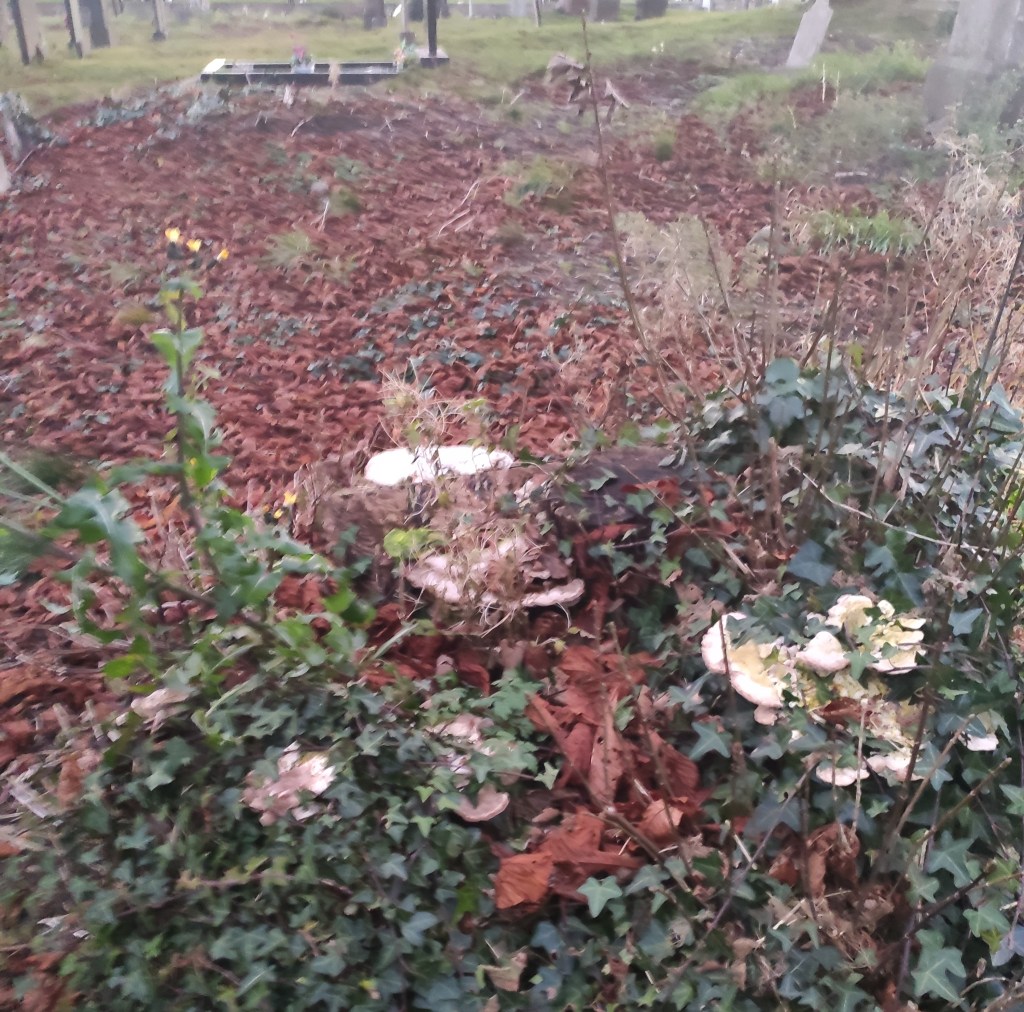
As all fungi do, Trametes gibbosa play an important part in our ecosystem, this particular widespread and common fungi belong to a group of fungi called white rot fungi. White rot fungi are particularly special as they are able to breakdown lignin, which not many other organisms can. It is therefore an important recycler enabling the surrounding elements of the ecosystem to reuse the nutrients and components that make up lignin. Recently white rot fungi are being closely looked at and utilised in bioremediation.
Basic Profile
Scientific name: Trametes gibbosa 1836 (initially called Merulius gibbosus) also Pseudotrametes gibbosa; Pseudotrametes gibbosa forma tenuis
Common names: Lumpy Bracket
Size of fruiting body: up to 20cm across, wide
Spores: hyaline 4-5.5 x 2-2.5µm
Gills: None, elongated pores on underside
Edibility: Inedible
Lookalikes: Blushing bracket (Deadelopsis confragosa) – less white pores, bruises dark pink and is more brown
On the Red Data List (extinct/critically endangered/endangered/vulnerable/near threatened): No

 Mushroomination