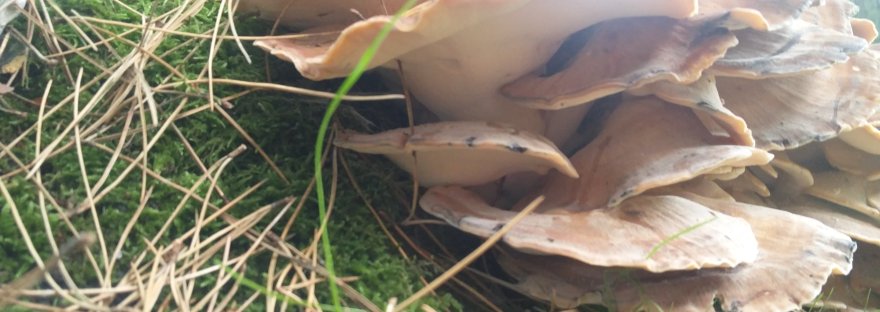
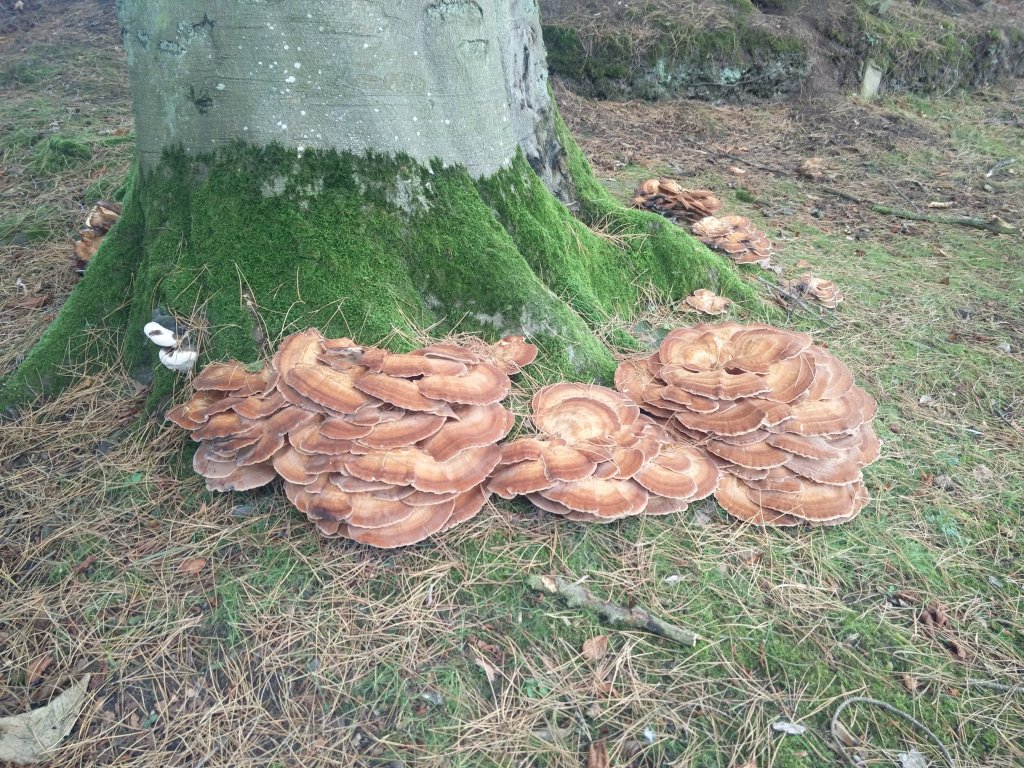
2018 I had the pleasure of visiting Langley Castle as my friend was having a fairytale wedding there. The morning after we went for a stroll around the grounds and discovered this fine specimen. I casually took this photo to identify later. I wish I had looked up and paid more attention to the tree, despite the pine needles all around, the bark on this tree looks distinctly like beech, which would fit with me thinking that this is the one and only Meripilus gigantea, aka Giant polypore or blackening polypore. The latter due to one of its distinguishing features being that it stains brown or black when bruised or cut.

Growing from a bulbous base, some of which can be seen above, the layers grow in a rosette or look lobe shaped. It is saprobic (meaning they live on dead plant matter) and parasitic. The giant polypore causes white rot to the tree, digesting lignin; it is said to weaken the roots initially, as that is how it first enters the tree.
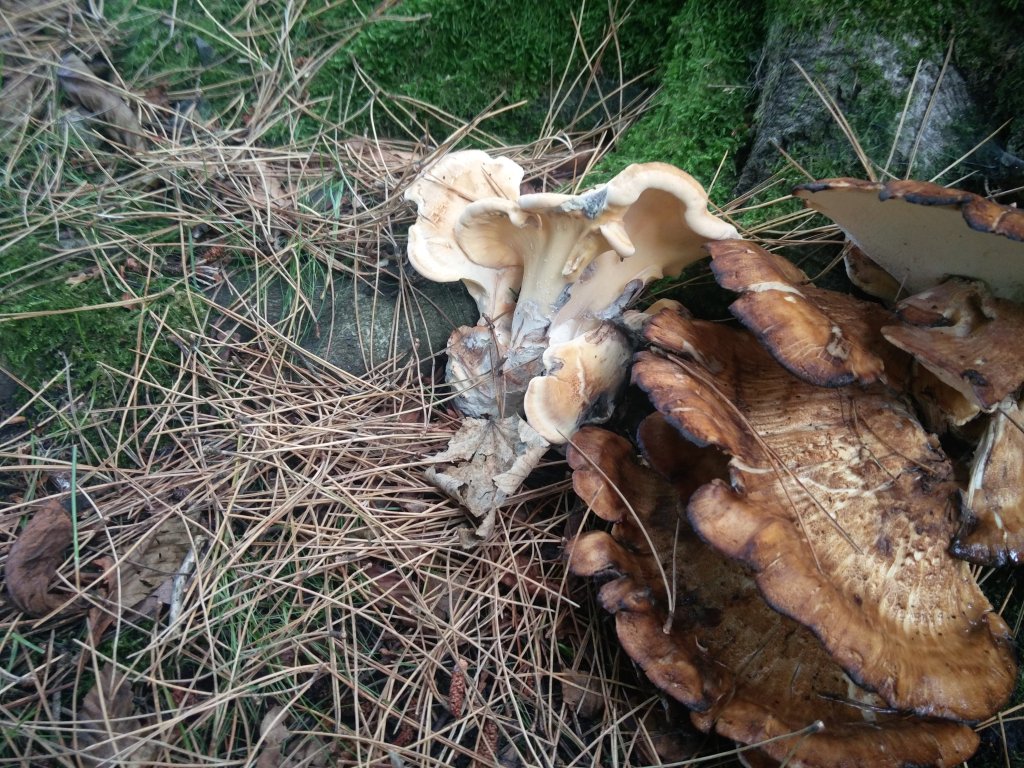
They are known to grow on roots appearing far from the tree, so if you see one you may need to have a look around more thoroughly to check for the host. It appears in summer to late autumn.
Cate2 for the UK has 2413 records of Meripilus gigantea, from the mainland of Britain and including the the Isle of Man and Isle of Skye, but more abundant in the south of England. The first record being from 1886 in the New Forest in mixed woodland, and the last at time of writing, being May 2022 in Newtown St Boswells in the Scottish Borders, recorded on a beech, Fagus sylvatica.
Basic Profile
Scientific name: Meripilus giganteus / Polyporus giganteus / Grifola gigantea
Common names: Blackening polypore; Giant polypore
Size of fruiting body: 10 – 30 cm wide / 1-2 cm thick, collectively can be 50-80cm wide
Spores: 5-6.5 x 4.5-6 µm
Gills: None, tubes and pores
Edibility: Some consider this edible, should always be cooked before consumption, research thoroughly and ensure you know before eating.
Lookalikes: Grifola frondosa (Hen of the woods) – topside is more grey, Laetiporus sulphureus (Chicken of the Woods) – topside is more orange and doesn’t bruise black
On the Red Data List (extinct/critically endangered/endangered/vulnerable/near threatened): No

 Mushroomination