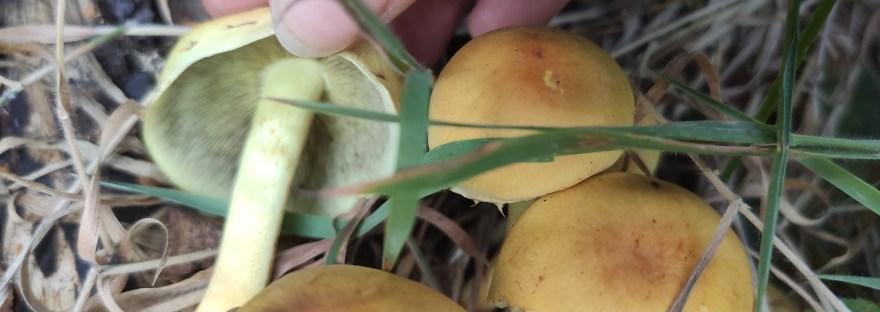

The wonderful Sherwood pines in Nottinghamshire is a brilliant space for cycling, mushroom hunting and also getting lost. I was happy to spot these whilst pootling around on one adventure. Clustered on a little pine stump itself covered with a montage of brambles, nettles and grass, these little sulphur tufts were glowing on the forest floor, I had to stop (and make my poor suffering parents stop) and check them out.

I was delighted to see their sulphurus coloured gills, characteristically the same colour as the stem and also had a hint of olive as they were aging. It was my first time noticing these distinctive fungi in real life, though they are common and widespread. I have really been missing out and the records reflect this, Cate2 shows them all over the British Isles, 16, 426 records at time of typing, and even the less resourced National Biodata Centre for Ireland has 209 records, dotted all over the country.
They fruit throughout the year, but are more numerous in summer and autumn. They are found on broadleaved and coniferous trees, and is another white rot fungus, able to break down lignin and cellulose. There is a faint ring on the stem, though I couldn’t see that on these, and when very young there can be veil remnants. Hypholoma fasciculare has been used experimentally as a fungicide, to try to eradicate an Armillaria species in British Colombia.
Basic Profile
Scientific name: Hypholoma fasciculare
Common English names: Sulphur Tuft
Size of fruiting body: 4-10cm x 0.5-1cm tall, 2-7cm wide cap
Spores: 6-8 x 4-4.5 µm
Gills: Adnate, sulphure, becoming olive
Edibility: Inedible – bitter – some sources say they are linked to fatalities
Lookalikes: Hypholoma capnoides
On the Red Data List (extinct/critically endangered/endangered/vulnerable/near threatened):

 Mushroomination