
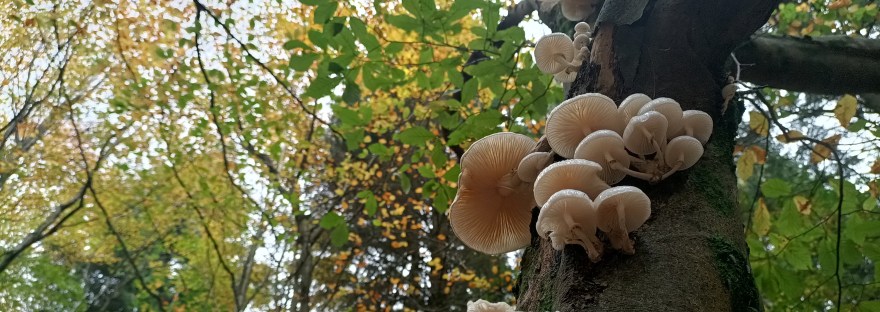
I remember when I first saw Mucidula mucida. I was on a Buddhist retreat in Co. Wicklow 5 years ago. The theme was connecting with nature. The retreat was very rural, with part of the Wicklow Way running along the top side of the property, Coillte forestry on the other side of the trail but the property itself was surrounded by old mixed woodlands. As it was a retreat, I was not using my phone or camera, yet I have a photographic memory of these individuals, delicate and glistening, with thin stems, arcing up to their pristine caps. They were unmistakable and immediately I could understand how they got their common English name ‘Porcelain Fungus’.

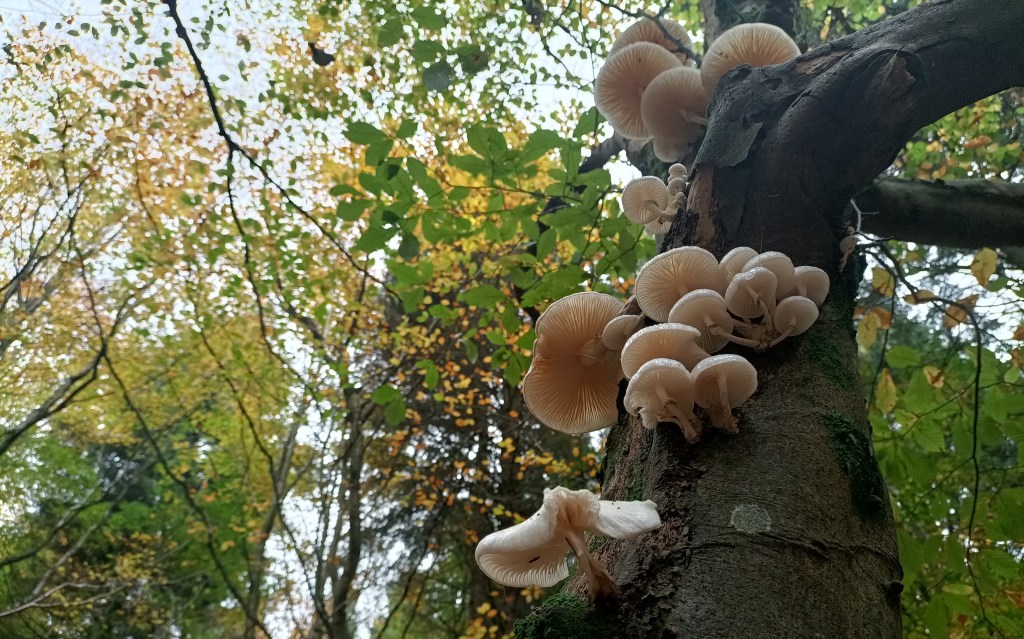
This year, I moved from the suburbs of Dublin to rural South Kildare. One of the many aspects I was looking forward to was finding nearby woods, forests and other habitats, to find fungi. In one nearby wood I have been exploring, next to the car park were a cluster of trees and I was stunned to see the extent of Porcelain fungi all the way up this huge beech tree. More in the centre of the woods another, slightly decayed beech tree also has a good fruiting of these. I find them completely mesmerising.

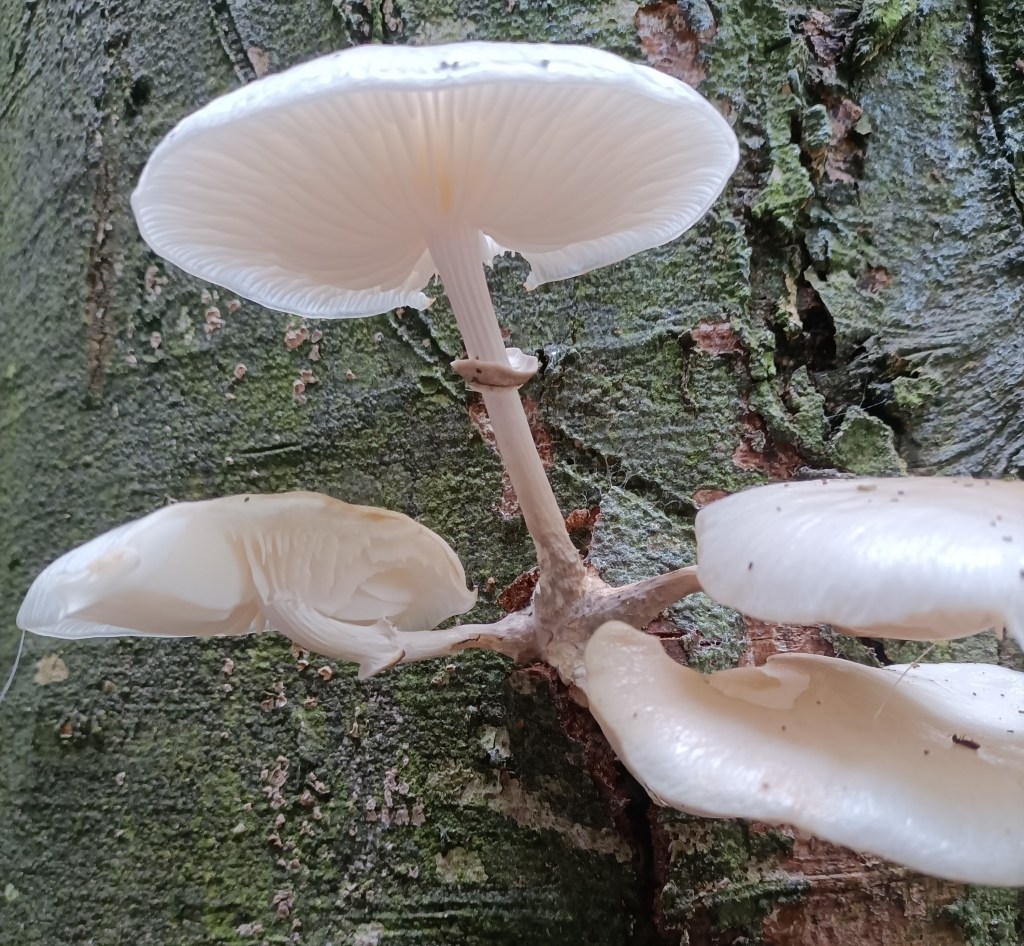
Their caps are slightly tacky hence ‘mucida’ – relating to mucus – in both names Mucidula mucida and Oudemansiella mucida. Both scientific names seem to be used, though Mucidula mucida is the newer name and seems to be used with greater frequency in the Facebook forums with various experts. Personally, I prefer Oudemansiella, named from the Dutch botanist ‘Oudemans’, but for me it’s onomatopoeic, when I see them I always let out an excited ‘oh!’.
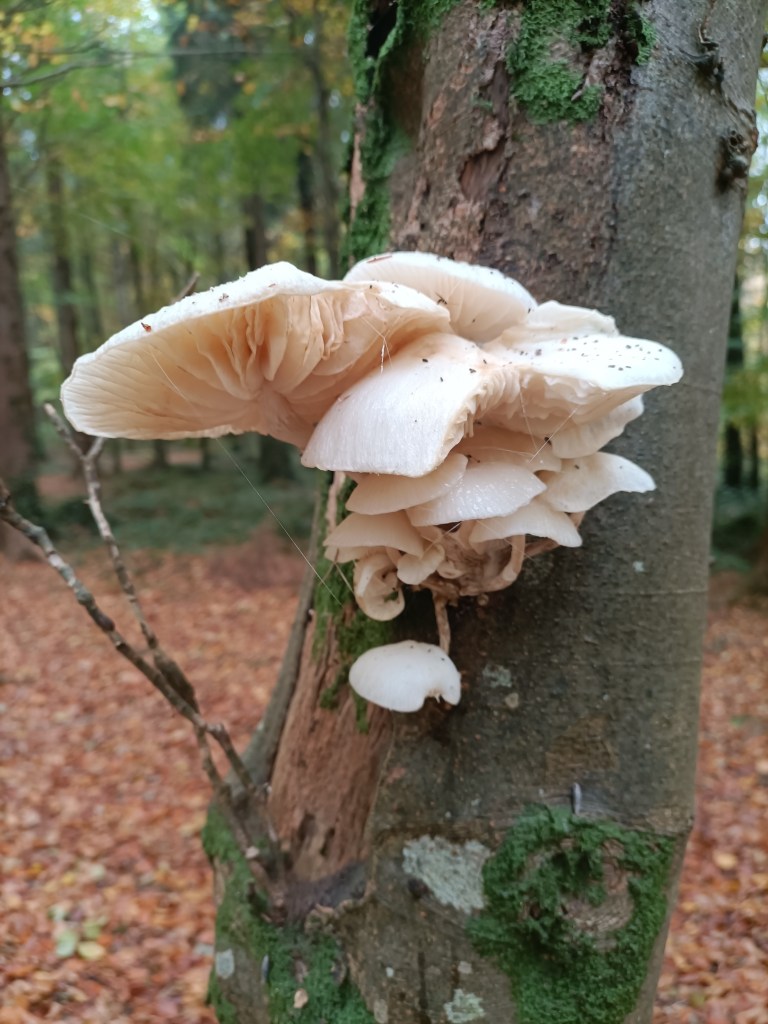

Mucidula mucida grows on dead or dying Beech trees (Fagus sp.). They are usually white but can be darker when young. The gills are widely spaced and particularly photogenic. They are adnate which means they are attached to the stipe in their entire depth. The skinny stipe is has a ring which marks a separation between different textures – very finely striate (marked with fine lines) above and below is finely scaly and slightly darker. They grow in clusters and can be found on stumps and high up on standing trees.


They are edible, but the mucus should be removed first. Even John Wright of the famed Mushrooms River Cottage Handbook reports that he was wary until he tried them and found they were ‘surprisingly rich in flavour’. Though First Nature reports them to not have a distinctive taste or odour.


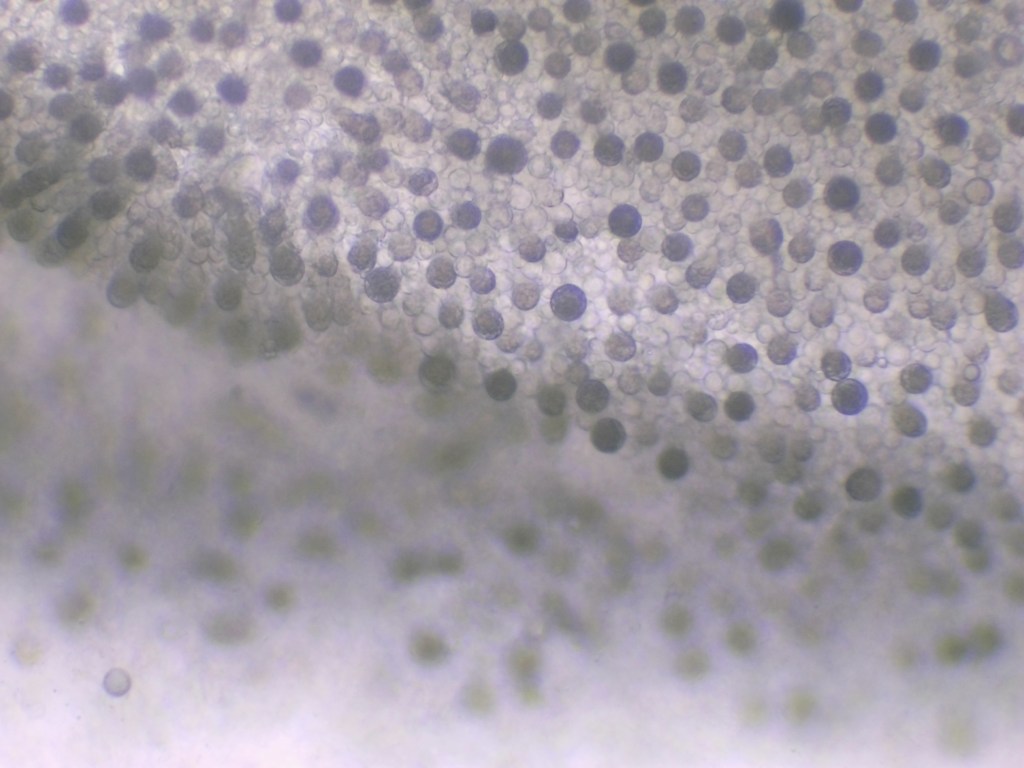
Oil Immersion lens
The spores are white, with a thick cell wall, spherical to subspherical and smooth. They are non-amyloid which means they don’t react to Melzer’s Reagent, although I’m not yet at that point in my self-taught microscopy journey yet, it’s an interesting thing to note.

Porcelain fungi are common and widespread throughout Britain and Ireland appearing June to early Winter. Cate2 database shows an abundance of records (3093) mainly from central Scotland down the country, and the largest concentration in the South of England. The records date from 1905 – 2024. As beech are native in the UK to the south-east of England and south-east Wales, this explains the local concentrations. For the Republic of Ireland records from the National Biodiversity Centre hold 45 records, evenly ish across the Provinces, dating from 1936 – 2019, May to November. In his book Mushroom miscellany, British mycologist Patrick Harding notes his first encounter of Porcelain fungi was in County Armagh.


These fungi have a couple of interesting applications due to chemical compounds present. The ‘Junior Nature Guide of Mushrooms and Fungi’ notes that ‘it is used to produce an antibiotic called mucidin which reportedly helps in the cure of skin fungi like athlete’s foot’. They have also been used to create fungicides used in forestry and agriculture.
Basic Profile
Scientific name: Mucidula mucida / Oudemansiella mucida
Common names: Porcelain fungus, Poached Egg Fungus, Slimy Beech Cap, Porcelain Agaric
Size of fruiting body: up to 8 cm tall, 2 x 10 cm cap, Dome shaped cap, flattening with age
Spores: 14 – 18 x 11-16 µm
Gills: Widely spaced, Adnate
Edibility: Yes
Lookalikes: I have seen these being mixed up with Oyster mushrooms (Pleurotus sp.) and Angel Wings (Pleurocybella porrigens), Porcelain Fungi have a few distinct characteristics such as the spindly stipe, tacky cap and its habitat being beech trees that can easily help to distinguish between these other species.
You can follow and connect with me on Instagram and Facebook.

 Mushroomination