

A Lesson and a Correction
In my 2024 Calendar I cited these as Scutellinia sp. I recently discovered it was something a little different.
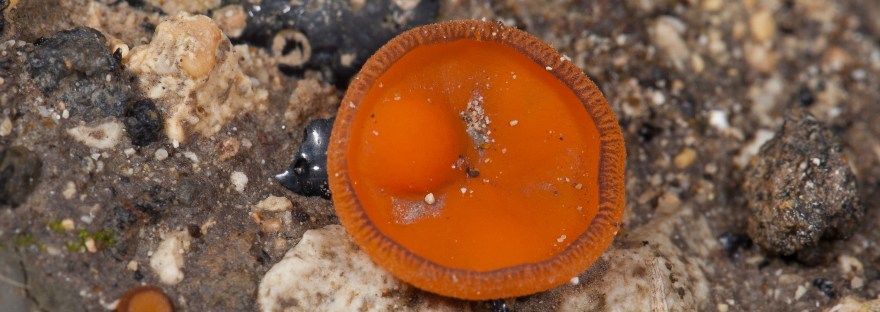
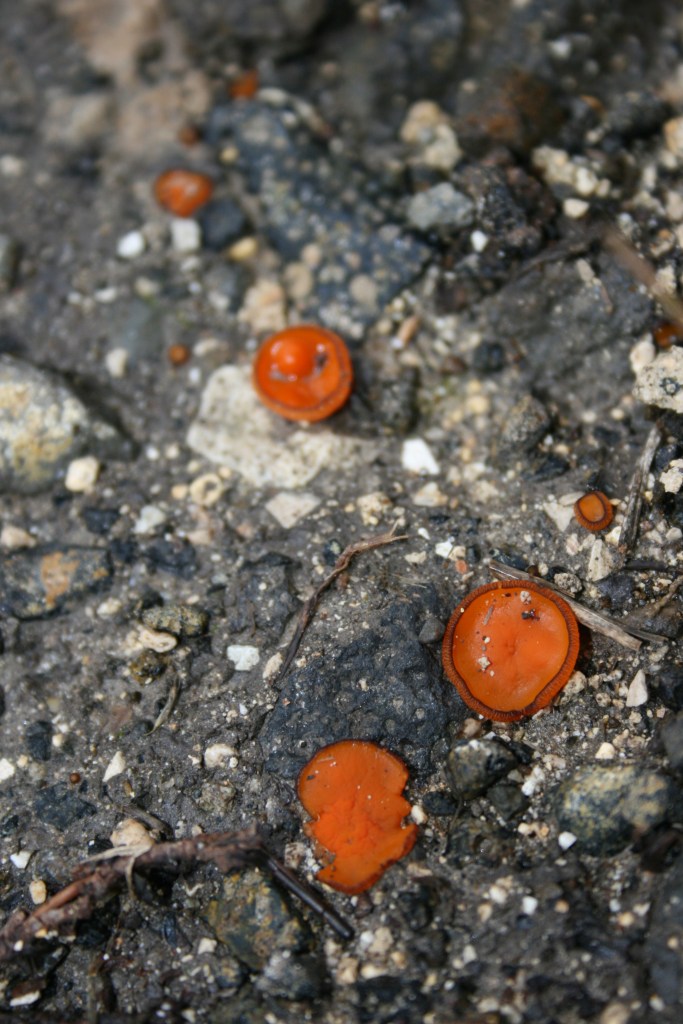
It’s been almost 10 years ago since I spotted these tiny orange discs in the gravel of a long driveway flanked by a neglected olive grove and agave in Sicily. The gravel had been laid recently and was mixed with earth. At the time I had thought they were Scutellinia. I’d been wanting to find Scutellinia scutellata since I’d read about it. These individuals were tiny (less than 1cm), vivid orange and with dark around the edge which I thought could be some type of hairs. I had some doubts, especially since the hairs on Scutellinia in my books didn’t look like this dark margin, but in my limited knowledge I shelved my doubts. It was definitely a case of trying to fit the fungi to the description in the book rather than fitting the description to the fungi.
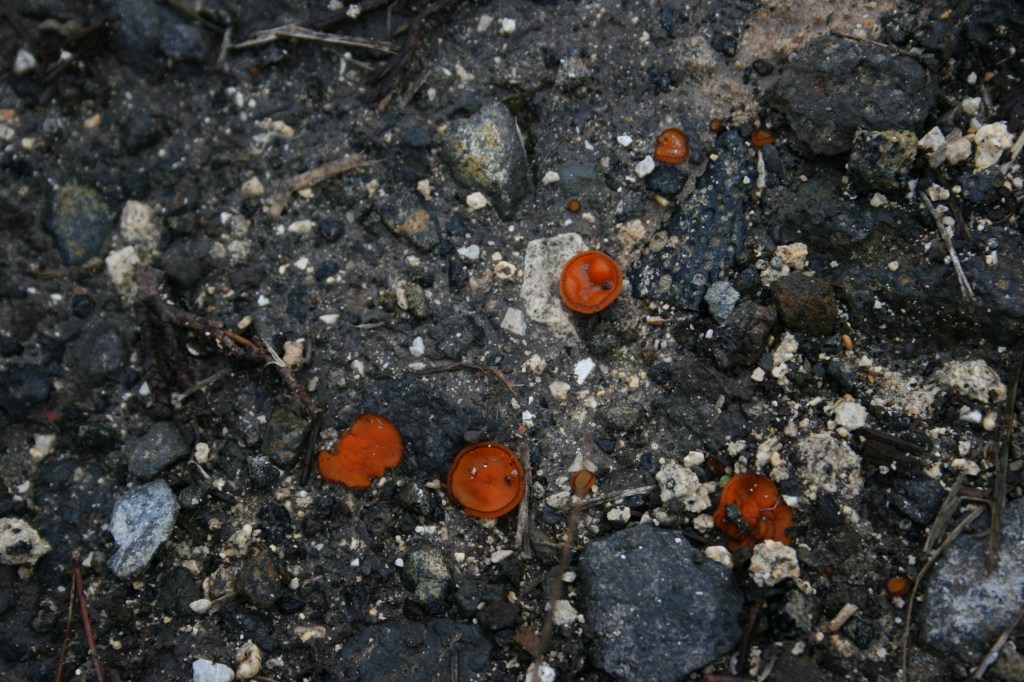
Fast forward to a few weeks ago, I spotted a very similar fungi posted on a Facebook group, an expert identified it as Melastiza species. I posted mine and the experts agreed Melastiza species.
Melastiza only appears in a couple of books in my small collection, namely The Encyclopedia of Fungi of Britain and Europe (Michael Jordan) and Collins Complete Guide to British Mushrooms and Toadstools (Paul Sterry and Barry Hughes).

Melastiza cornubiensis (synonym Melastiza chateri,) common English name ‘Orange Cup’ is described as having a conspicuous hairy margin, to 1.5cm, shallow cup or disc shaped, becoming irregular and undulating, appearing between spring and autumn, infrequent clustered on sandy and gravelly soils. The discs have a prominent margin covered in small tufts of brown hairs. Jiří Moravec notes that ‘the colour and density (or even occurrence) of the apothecial marginal hairs is also extremely diverse’ . Orange cups are said to be widespread but uncommon.
Melastiza scotica is similar to cornubiensis, but larger and paler to 3 cm, said to have inconspicuous hairs and appear solo or in small groups. Their preferred habitats are soil or mosses in coniferous woodland and like cornubiensis is uncommon but with most records hailing from Scotland.
I couldn’t find a database for Italy or Sicily, if any one knows of one please let me know. For the UK, I discovered two more sub species of Melastiza recorded on Cate2 – the Fungus Conservation Trust’s records database for the UK. These are M. contorta and M. Flavorubens. M. chateri and M. Cornubiensis are recorded separately, 210 and 172 respectively, recorded mostly in England, a couple from Scotland and none in NI, M. Contorta and M. Scotica have 74 and 11 records, both have the majority of records in Scotland. M. flavurobens has just 9 records, mostly clustered around N. Yorkshire.
An interesting article published in 1994¹ on Czech Mycology.org by mycologist Jiří Moravec examines the similarities between Melastiza and Aleuria species, proposing Melastiza species should be a separate subgenus of Aleuria due to even microscopic similarities. It has very detailled drawings of various microscopic elements. The proposal doesn’t seem to have caught on, perhaps with advancements in other areas of identification, but it does illustrate the potential of confusion, especially for an amateur.
I can’t be certain what these are, but they have been a lesson in listening to my intuition and doubts and being open to uncertainty. The drive to identify and to improve my knowledge is strong, but that has to come with patience and proper observation. As I accummulate more resources, more first hand studying and research things my knowledge will grow, but the world of mycology is more vast than can be imagined and that is one of its infinite wonders.
Lookalikes:
Aleuria sp. (see above)
Scutellinia scutellata live on damp rotted wood and the hairs are longer
Scutellinia olivascens are 2cm across and live on damp rotted wood or soil
Anthracobia macrocystis can be found on old bonfire sites
Coprobia granulata grow on cow dung
You can follow and connect with me on Instagram and Facebook.

 Mushroomination