
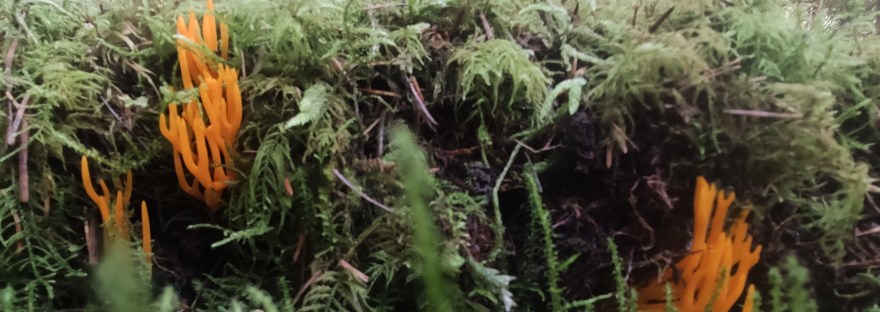
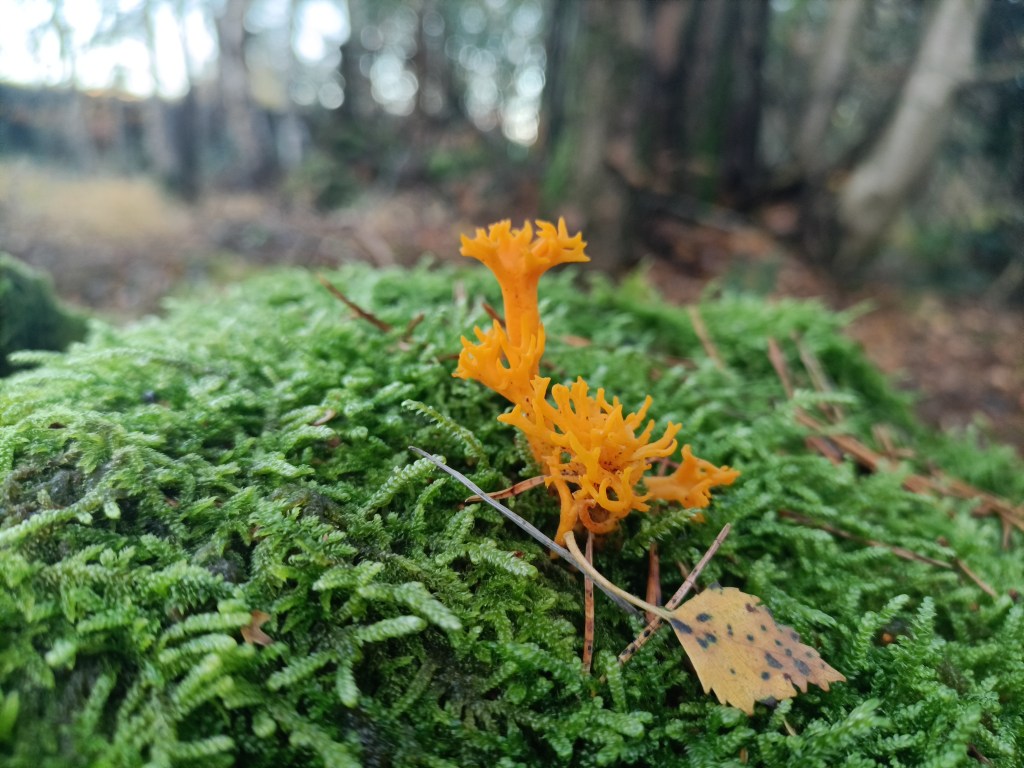
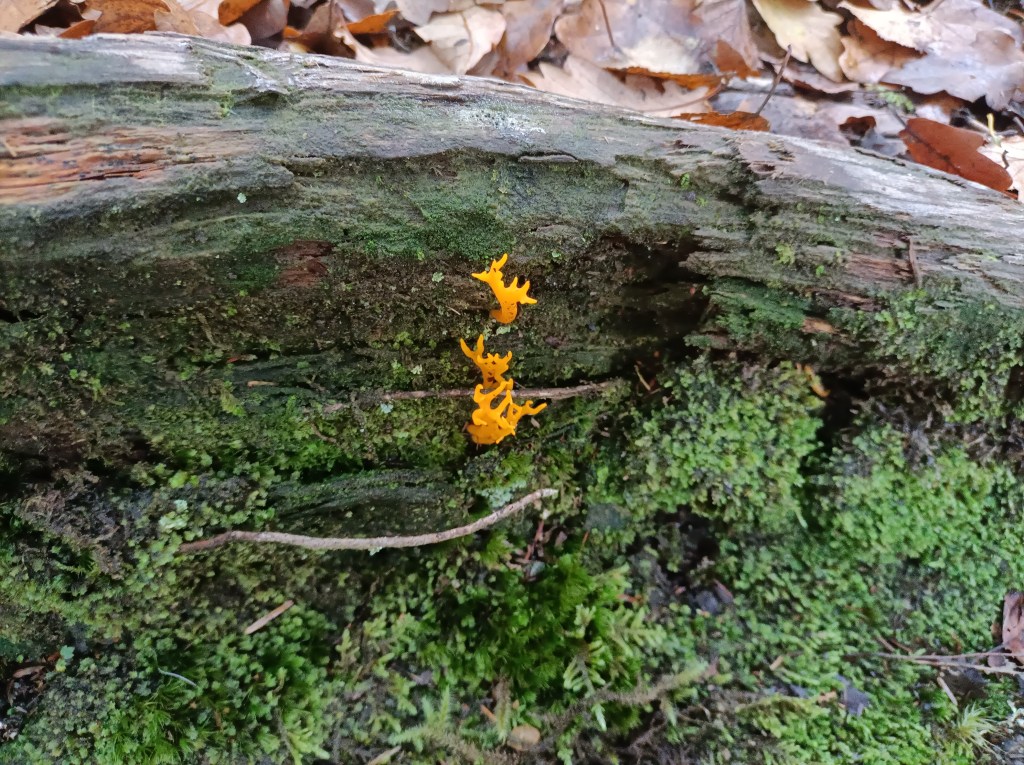
Calocera viscosa, common English name Yellow Stagshorn. These little yellow antlers grow from dead conifers, including stumps and roots. Some may look as though they grow from soil but a little digging can reveal buried wood or long roots penetrating into tree roots. Their beautiful bright yellow colour beaming from the ground or from decayed wood is one of my favourite things to spot in dark woods and forests.
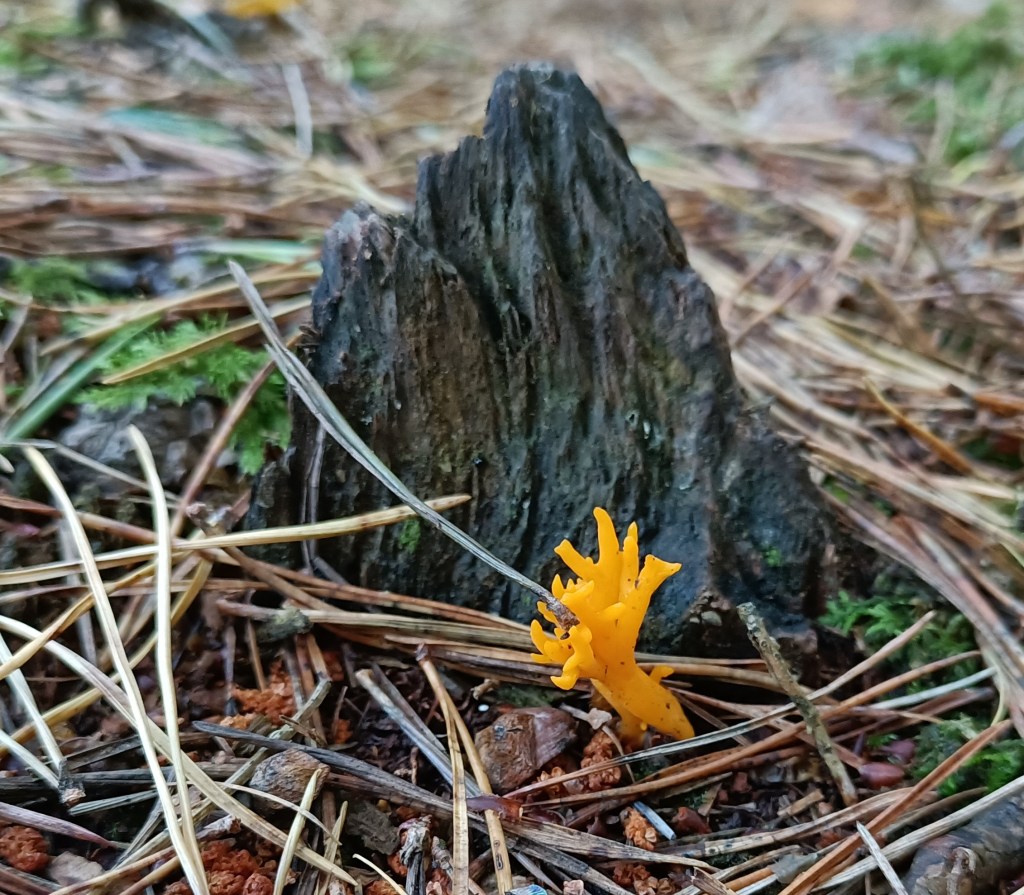
Usually appearing as if in clusters, with fruit bodies fused at the base, Yellow stagashorn have subtle white where they adjoin. The branched trunk divides into 2 or 3 blunt ends at the top. They are tough, rubbery and flexible which helps to tell them apart from some potential lookalikes. ‘Collins Complete Guide…’ mentions that the ‘trunk’ is sometimes longitudinally grooved – as can be seen on the first image of the post. They feed on the decaying wood that is their substrate. They are not edible and have no distinct taste yet one book in my collection also notes that they ‘rarely lead to gastric complaints’.

They are widespread and locally common in Britain and Ireland, most parts of Europe and other regions across the world. They are most often seen in Autumn and Winter, but fruit all year. I have seen them in County Dublin, County Wicklow in Ireland, and in the Brecon Beacons in Wales, in August, October and November. A white version of Calocera viscosa (var. cavarae) exists also.
Jelly Fungi Family
Calocera viscosa belong to the division of fungi called Basidiomycota, and were part of an obsolete group called ‘Heterobasidiomycota’ which were separated from other Basidiomycota as they have septate basidia. Septate simply meaning divided/having a septum, and basidia referring to the ‘microscopic club-shaped spore-bearing structure produced by certain fungi’.


Now categorised as part of the Dacrymycetaceae family within Basidiomycota. They are grouped within the informal ‘Jelly Fungi’ group, which are characterised by their ability to withstand dessication and subsequent revival. I tested this out as I had taken a specimen from Wicklow for microscopy and it dried out quickly in my bag. It had been dried, out of the ground for over 30 days. I put it in a little pot of water and within a few hours it had revived.
Other Calocera species
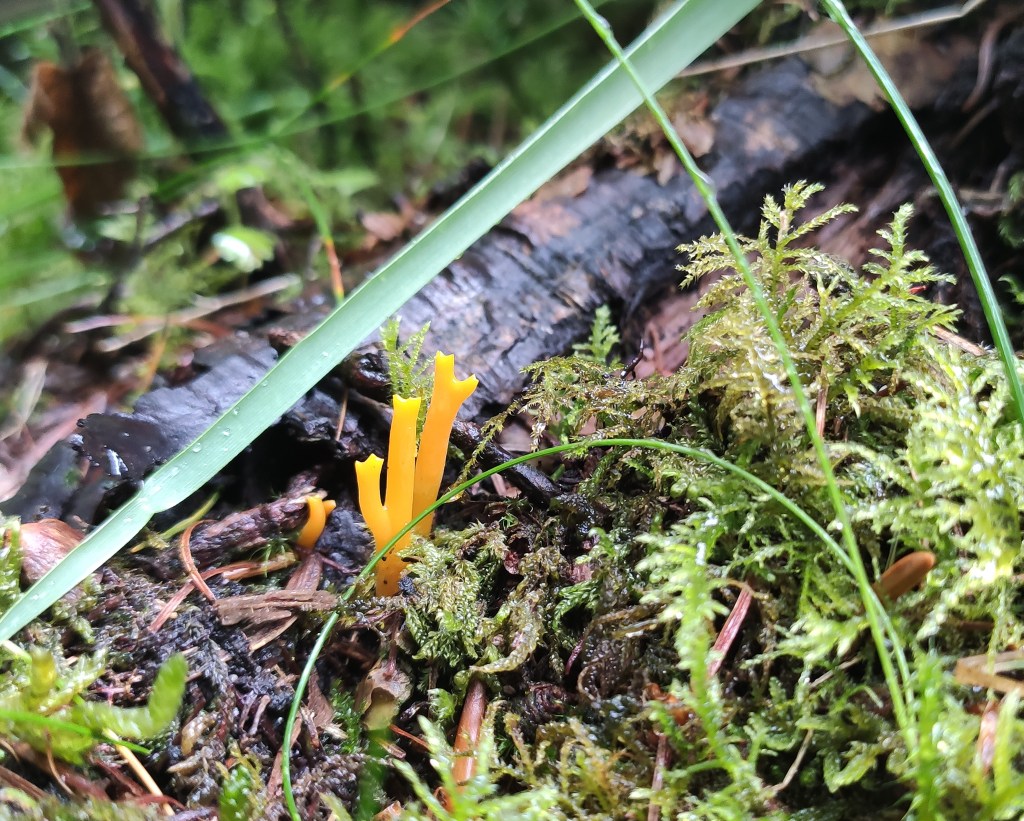
The Calocera are so named for their ‘Beautiful’ and ‘Waxy’ appearance. Most noted similar Calocera species include C. pallidospathulata, common English name Pale stagshorn, differing from viscosa as it becomes paler as it ages and has a spoon-like or twisted end, rather than branched. First spotted in the UK in 1969, C. pallidospathulata is now widespread, its known habitat is conifer and deciduous trees and only grows to around 1.5cm tall.
Calocera cornea, known as small stagshorn, is usually unbranched, on deciduous wood, particularly beech. It is yellow, similar to C. viscosa but only grows to around 1cm tall.
Calocera glossoides grows in a small yellow club shape, in dense groups on dead broadwood favouring oak.
Other lookalike species

Members of the Dacrymycetacales Class are typically have carotenoid pigments resulting in them being shades of yellow to orange, and include clavoroid fungi which could be mistaken for Calocera. Members of the Clavariaceae family (a family which inludes clubs and corals) can also be similar differing from Calocera sp as Calocera are less brittle and found on wood, and some Clavariaceae are biotrophic, and don’t grow from wood.

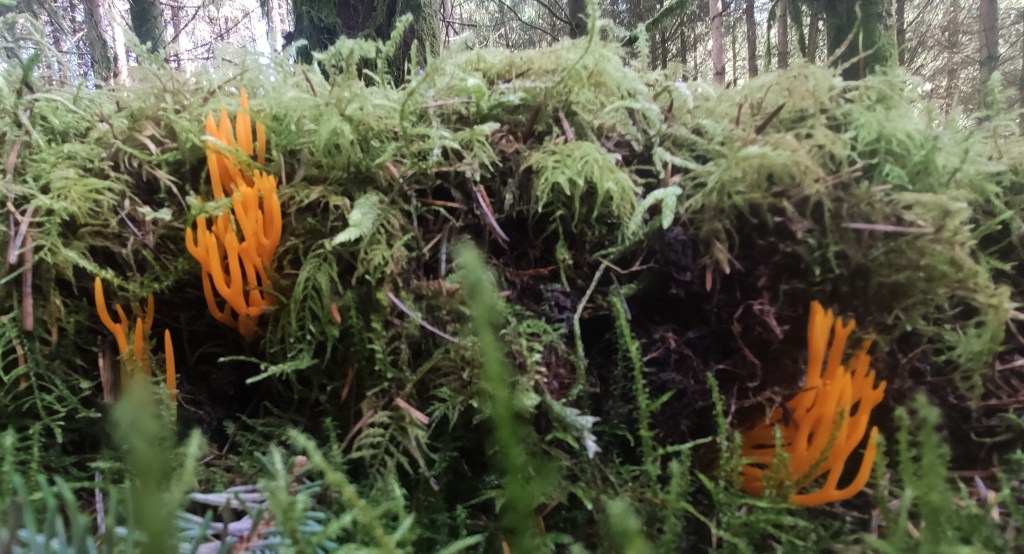
Roy Watling, in his book on Dawyck’s Fungal Heritage note that ClaThey are distantly related but microscopically very different as denoted by Roy Watling in his book on Dawyck’s Fungal Heritage. The fungi above found in the Brecon Beacons, I had initially thought they were Yellow Stagshorn and now know I should have dug deeper!
Basic Profile
Scientific name: Calocera viscosa
Common names: Yellow Stagshorn, Jelly Antler Fungus, Jelly Stagshorn
Size of fruiting body: 10cm tall, cm wide
Spores: hyaline, ellipsoidal, 9-12 x 3.5-4.5 µm
Gills: Nil
Edibility: Tasteless, tough
Lookalikes: As above, C. pallidospathulata, Calocera cornea, Calocera glossoides, and Ramariopsis species though habitat, texture and substrate give the most clues to differentiate.
On the Red Data List (extinct/critically endangered/endangered/vulnerable/near threatened): No
You can follow and connect with me on Instagram and Facebook.

 Mushroomination