
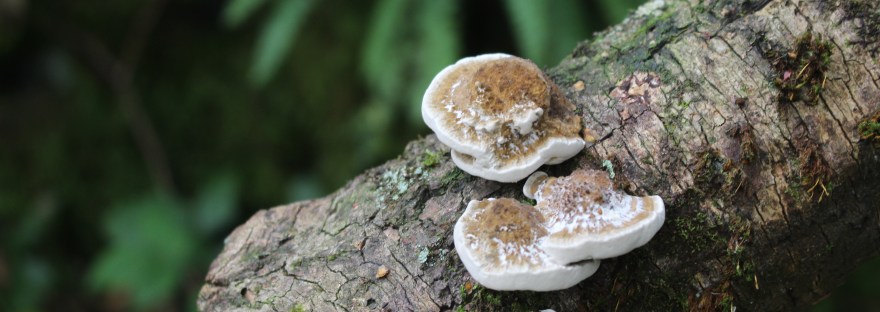

I am rolling the clock back to September 2020, when I first went to what has become one of my favourite foraying spots in County Wicklow. The abundance and diversity of species took me off guard and I spotted many different fungi including boletes, brackets, puffballs, cauliflower fungi, fly agaric, Elfin saddle, and many more.

I was struck by the beauty of the pores of one particular species, appearing on branches and trunks of birch. These turned out to be Daedaleopsis confragosa, Blushing Bracket. A fascinating polypore that favours dead or dying wood of deciduous trees including willow, birch, beech, hazel and ash. It is in the group of white rot fungi, which have the unique ability to breakdown the lignin part of wood which has an extremely complex chemical composition.

Younger specimens I spotted were thick, up to 1 – 2cm and somehow reminded me of tiramisu with their ochre speckled top side. At first, I was unsure if they may have been Lumpy Bracket, Trametes Gibbosa, but after looking at the pores confirmed it to be Blushing Bracket. The pores, described as a ‘labyrinth’ in the Collins Complete Guide to British Mushrooms and Toadstools, can be round, angular or slit like. Labyrinthine pores are also referenced by this fungi’s name as Daedalus was the creator of the labyrinth on Crete. The pores bruise dark pink.
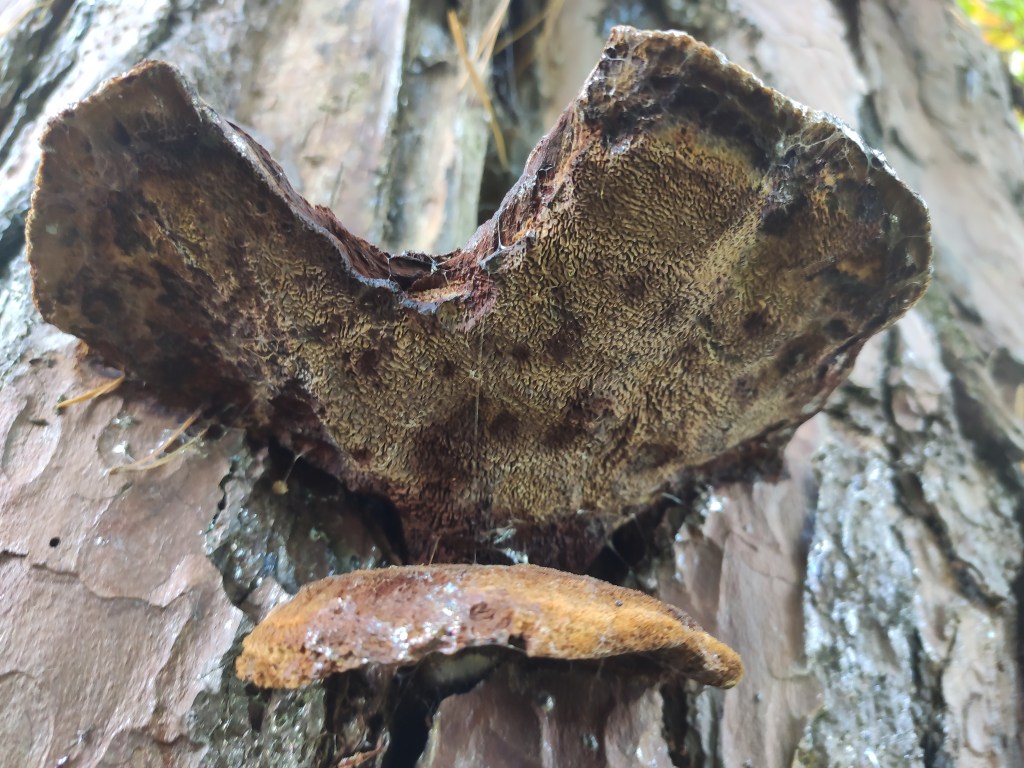
The fruiting bodies are kidney shaped and be on their own or appear in tiers. The upper surface starts off ochre, with concentric zones, and a white margin. The topsides eventually turn dark. Though they can be seen all year round, they sporulate from late summer to autumn. In some individuals, reddish brown colouring can be seen on the upper surface and on some reddish colour can completely cover the upper side. As in the older specimen below. The common English name ‘Blushing Bracket’ refers to this mauve/red colouring.
Blushing brackets are said to have no odour and a taste which is slightly bitter but they are not considered edible. There have been limited studies on this fungi appearing to show antibiotic, antihypertensive and anti-tumor effects – an article on Healing-Mushrooms.net does a great job of summarising the studies in plain English and has links to the original studies.


Daedaleopsis confragosa is a common and widespread fungi appearing all over Europe and Eastern North America and parts of Asia.
There is a mere 9 records of Daedaleopsis confragosa on our National Biodiversity Data Centre records, from 2000 and 2021, the earliest in March and the latest in November. They are concentrated to Wicklow and mid North East. Cate2 for the UK holds 10,228 records, with a fairly even spread across England, Wales and up to the midlands of Scotland. The earliest from 29th August 1867 and latest record on the 30th January 2025. The comprehensive and historical nature of Cate2 is one of the reasons I love it. It’s such a great resource.
This is a great polypore to look out for all year round, identifiable by its upperside, its unique and beautiful pore structure and the pores bruising red.
Basic Profile
Scientific name: Daedaleopsis confragosa
Synonyms: Trametes confragosa; Trametes rubescens; Boletus confragosus
Common English Names: Blushing Bracket; Blood-stained bracket; Thin-walled Maze Flat Polypore
Size of fruiting body: 5-20cm x 1-4cm thick
Spores: 7-11 x 2-3 µm hyaline,smooth cylindrical with droplets, cystidia absent
Gills: Pores – creamy, ochraceous bruising reddish, irregular, elongated radially, 1-2mm tubes, 5-10mm deep
Edibility: Not edible
Lookalikes: Trametes gibbosa – Lumpy Bracket could be confused, but distinguished as Blushing brackets elongated pores are more white and there is a more even upperside, pores of Lumpy Bracket do not have a red flush. Daedalea quercina could also be mistaken, differentiated as the pores are all in a maze like form.
On the Red Data List (extinct/critically endangered/endangered/vulnerable/near threatened): No
You can follow and connect with me on Instagram and Facebook.

 Mushroomination